Democracy to Come by Dallmayr Fred;
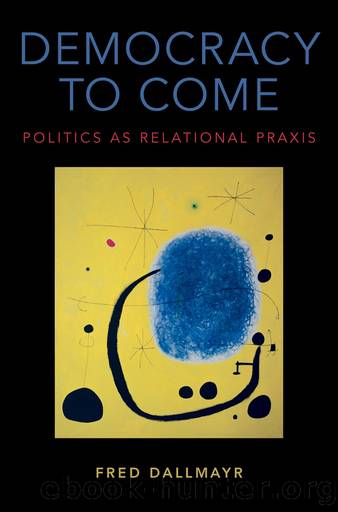
Author:Dallmayr, Fred;
Language: eng
Format: epub
Publisher: Oxford University Press USA - OSO
Published: 2017-10-15T00:00:00+00:00
MANY SEASONS, MANY TRANSITIONS
In its tight argumentation and lucid formulations, Democracy, Human Rights and Law in Islamic Thought is an impressive text, and clearly a major contribution to contemporary Islamic political philosophy. What is particularly noteworthy is the emphasis on the difficulties involved in the transition to democracy in the Muslim world, and especially on the complexity of the social fabric which needs to be taken into account. One wishes that some of the leaders of the Arab Spring had paid closer attention to al-Jabriâs arguments and sober warnings. Clearly, establishing a viable democracy requires more than youthful enthusiasm and gun-toting machismo; as Gandhi always insisted, the means of democratization have to be congruent with the desired end. In this respect, the path chosen by the leaders in Tunisia stands out as an exemplary application of al-Jabriâs recommendationsâand this despite some rough episodes and recent attempts at disruption. The hard labor and intelligence invested in institution-building and constitutional design can serve as an inspiration for other countries seeking to establish a democratic regime not just for one âspringâ but for many seasons to come. Inevitably, the reflections of a comparative theorist will wander to other examples of slow, painstaking efforts of constitution-building, such as the deliberations of the Constitutional Convention in the United States (1787), or the constitutional initiatives after World War II in such countries as Germany, Italy, Japan, and Korea.
I mention the latter examples not to support any simple transfer of democratic models across countries, but simply to show the possibility of dialogical learning. Such learning, however, is radically different from foreign intervention and imposition. As pointed out before, al-Jabri is adamant in rejecting intervention, and especially the ideologyâpopular in the Westâof liberal âregime change.â This policy, he insists, invariably backfires. Due to the ignorance of history and local conditions, it usually produces more harm than good (and often immense misery and destruction). Again, to restate a previous point, rejection of foreign intervention has nothing in common with parochialism or a refusal to engage actively the âwinds of change.â As a broadly trained philosopher, al-Jabri was quite familiar with the Hegelian âdialecticâ of universalism and particularism and the mutual implication of the two terms. What he opposed is basically the arrogant self-identification of some hegemonic countries with universal civilization, an arrogance which historically has fueled the projects of imperialism and colonialism. On the other hand, he is by no means supportive of a nostalgic traditionalism averse to innovative learning processesâand thus averse to history and temporality as such. As he writes pointedly, âThe model to be followed in order to rebuild ourselves, and safeguard against obliteration, is not that of [distant] âpredecessorsâ which poses as a self-sufficient world.â Rather, âit should encompass the entire historical experience of our nation, and it should learn from the historical experience of other nations who are, like us, struggling to protect their existence.â26
If I have some qualms about his work, it has to do mainly with an occasional tendency to suspend dialectic or (better) dialogical learning in favor of rigid antinomies.
Download
This site does not store any files on its server. We only index and link to content provided by other sites. Please contact the content providers to delete copyright contents if any and email us, we'll remove relevant links or contents immediately.
| Anthropology | Archaeology |
| Philosophy | Politics & Government |
| Social Sciences | Sociology |
| Women's Studies |
The Secret History by Donna Tartt(19477)
The Social Justice Warrior Handbook by Lisa De Pasquale(12297)
Thirteen Reasons Why by Jay Asher(9132)
This Is How You Lose Her by Junot Diaz(7060)
Weapons of Math Destruction by Cathy O'Neil(6483)
Zero to One by Peter Thiel(5953)
Beartown by Fredrik Backman(5951)
The Myth of the Strong Leader by Archie Brown(5631)
The Fire Next Time by James Baldwin(5592)
How Democracies Die by Steven Levitsky & Daniel Ziblatt(5333)
Promise Me, Dad by Joe Biden(5238)
Stone's Rules by Roger Stone(5196)
A Higher Loyalty: Truth, Lies, and Leadership by James Comey(5092)
100 Deadly Skills by Clint Emerson(5032)
Rise and Kill First by Ronen Bergman(4908)
Secrecy World by Jake Bernstein(4892)
The David Icke Guide to the Global Conspiracy (and how to end it) by David Icke(4854)
The Doomsday Machine by Daniel Ellsberg(4627)
The Farm by Tom Rob Smith(4614)
